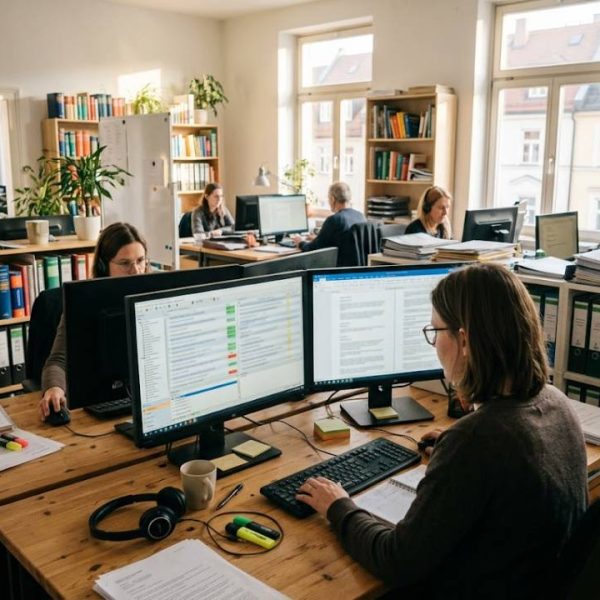
A mid-sized translation office in Germany can easily receive requests in forty or more languages in a single week. A birth certificate from Ukraine, a supply contract for Turkey, a machine manual for Brazil, a court summons in Arabic. Each job may involve a different translator, often working remotely in another country.
Without a shared system, that diversity quickly turns into chaos. The same client's company name appears three different ways, recurring paragraphs are translated from scratch every time, and nobody can find last year's version. Consistency at that scale is not a matter of discipline alone; it depends on infrastructure.
The problem with scattered files
Many smaller offices still run on email attachments and folders. A project manager receives a file, forwards it to a freelancer, receives the translation back, checks it and sends it on. It works, until it does not.
Files get lost in inboxes. Two translators work on different versions of the same document. A client asks for a small update to a manual translated two years ago, and the original translator has moved on. Every one of these situations costs time and introduces risk.
Memory as the office's long-term asset
The most valuable resource a translation office owns is not its client list. It is the collection of approved translations it has produced over the years. Stored segment by segment in a translation memory, those sentences can be reused whenever similar text appears again.
For an office handling repeat business, that reuse adds up quickly. Annual reports, product catalogues, standard contract clauses, safety warnings and certificate templates follow familiar patterns. Linguists see previous solutions immediately, accept them where appropriate and focus their energy on what is genuinely new.
One environment for every language
Modern offices increasingly run all their language work inside a single online cat translation tool. Project managers upload source files, assign languages and deadlines, and translators open their tasks in a browser. Memories, glossaries and quality checks travel with every job automatically.
The benefits go beyond convenience. Formatting is preserved, so a translated Word or InDesign file comes back with the same layout as the original. Numbers, dates and tags are checked against the source. Reviewers see exactly what changed. And when a client sends an updated document, the system recognises the unchanged sentences and shows only the new or edited ones.
Certified translations still need people
Software does not replace the sworn or authorised translator who signs a certified translation. In Germany, that signature carries legal weight, and the translator remains personally responsible for accuracy. What software does is support that person. It keeps names consistently spelled across a family's documents, ensures stamps and annotations are not overlooked and makes it easier to produce several certified copies in a standard format.
The translator decides; the system remembers. That division of labour suits certified work well.
Terminology across dozens of clients
Each client has its own vocabulary. An engineering firm insists on particular terms for its components; a law firm prefers specific phrasing for standard clauses; a hospital uses its own department names. A shared termbase stores these preferences per client and per language, and the translator sees them while working.
When a new freelancer joins a long-running account, they inherit years of terminology decisions on day one. That continuity is something clients notice, even if they never see the system behind it.
Interpreting assignments benefit too
Offices that also provide interpreters can use the same terminology resources for event preparation. Before a technical conference or a court hearing, interpreters receive glossaries built from previous written projects for the same client. Written and spoken language stay aligned, which is particularly valuable in legal and medical settings.
Security and data protection
Translation offices handle passports, medical reports, court files and confidential business plans. A central platform with access controls, encrypted storage and clear retention rules is far safer than documents circulating in personal email accounts. It also makes it easier to demonstrate compliance with European data protection rules when clients ask how their information is handled.
What changes for clients
From the client side, the improvement shows up as faster turnaround on repeat work, more predictable pricing thanks to reused content and fewer inconsistencies between documents. Larger clients may even get direct access to review translations or download finished files from the same platform their translators use.
Clients comparing providers should look for a translation agency that combines this kind of infrastructure with qualified native linguists for every language pair. The best agencies publish their quality process, from translator selection to final review, and can show reference projects in your industry. Choosing a partner with both technology and human expertise is what turns a one-off job into a reliable long-term relationship.
Getting started without disruption
Switching from folders to a shared platform does not have to happen overnight. Many offices begin with their largest repeat clients, import existing translations to build initial memories, and add other accounts gradually. Freelancers usually adapt quickly, since browser-based editors require no installation.
Growing without losing control
Adding new languages or new translators used to mean adding complexity. With shared memories, termbases and workflows in one place, a translation office can grow its language portfolio while keeping quality steady. For clients who need everything from a sworn translation of a birth certificate to a multilingual product launch, that reliability is exactly what they are paying for.